Sample Honeymoon · Chile and Bolivia
Atacama to Uyuni: A Honeymoon Across the Highlands
San Pedro de Atacama · Eduardo Avaroa Reserve · Salar de Uyuni
What's Included
- 3 nights Explora Atacama, 2 nights private camps, 2 nights Explora Uyuni
- All meals, wine pairings, open bar
- Bilingual WFR-certified guides
- Private 4x4 across Bolivia
- All transfers, border permits, reserve fees
Not Included
- Flights to Calama (CJC) and from Uyuni (UYU)
- Travel insurance
- Optional Tunupa Volcano half-ascent
- Tips & gratuities
- Pre-trip nights in Santiago or La Paz
Why this trip
I've crossed this route. It stays with you.
You start in the Atacama: the driest desert in the world, copper-coloured hills, sky so clean the stars feel close. Three days later you're climbing past 14,000 feet through Bolivia. Mineral-bright lagoons in colours a paint store doesn't carry. A geyser field at sunrise that smells like the inside of the earth. A stone tree alone in the dust. Pink flamingos in red water. And then, on the last morning, you walk out onto the largest salt flat on the planet, a white nothing that turns mirror after the rains, where your reflection meets the sky.
For couples drawn to a honeymoon that isn't a beach, this is one of the most uncommon, most cinematic journeys on Earth. It's also a trip that needs to be planned right. The altitude, the borders, the remoteness, the cars: all of it deserves an operator who has thought about every variable.
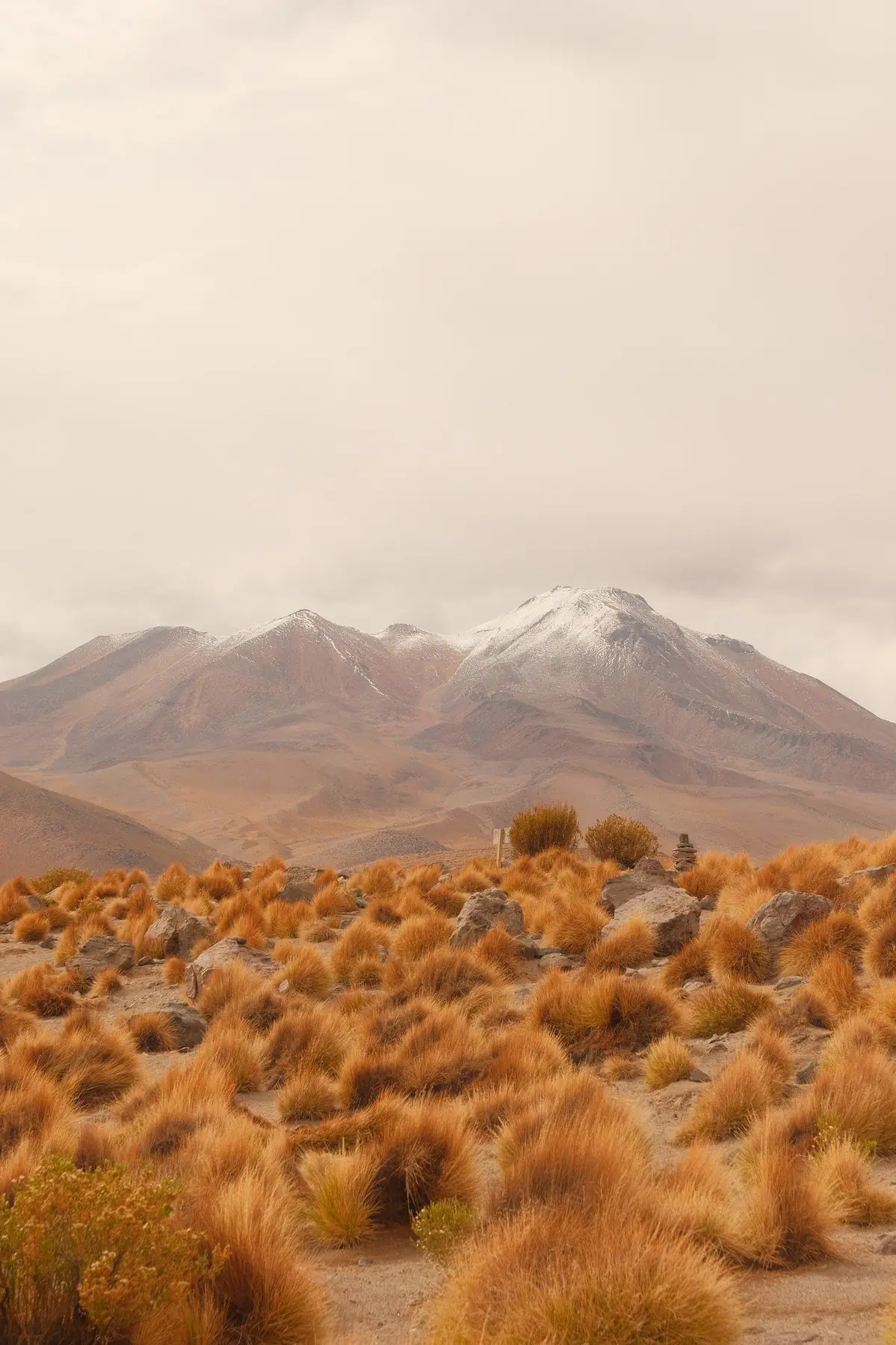
The Andes from the high plateau, somewhere east of the border.
I made this crossing privately, and Explora is how I'd send you: for the continuity of staff and vehicles across both countries, the private camps in places no hotel could be built, and the rhythm of days that feels designed rather than improvised. The trip ends at Uyuni rather than circling back to Atacama, so from there you can fly home or carry on to a longer honeymoon.
A general overview of the exploration: the lodges, the landscape, the rhythm of the Travesía.
Atacama, Chile
Arrival, Acclimatization, the Driest Desert on Earth
Fly into Santiago, then connect to Calama (CJC). A driver collects you for the ninety-minute transfer to San Pedro de Atacama at 2,400 m / 7,900 ft. This is the lowest altitude of the trip and where you give your body time to adjust. Drink water relentlessly. Sleep early. Take it easy on day one.
You're climbing to 4,200 m on day four, so your body needs the buffer. While you're acclimatizing, the things worth doing: Valle de la Luna at golden hour, Laguna Cejar for a salt-water float with the Licancabur volcano on the horizon, El Tatio Geysers at dawn (4:30 a.m. departure, cold, worth it), and a sunset dinner in the desert if your hotel offers one.
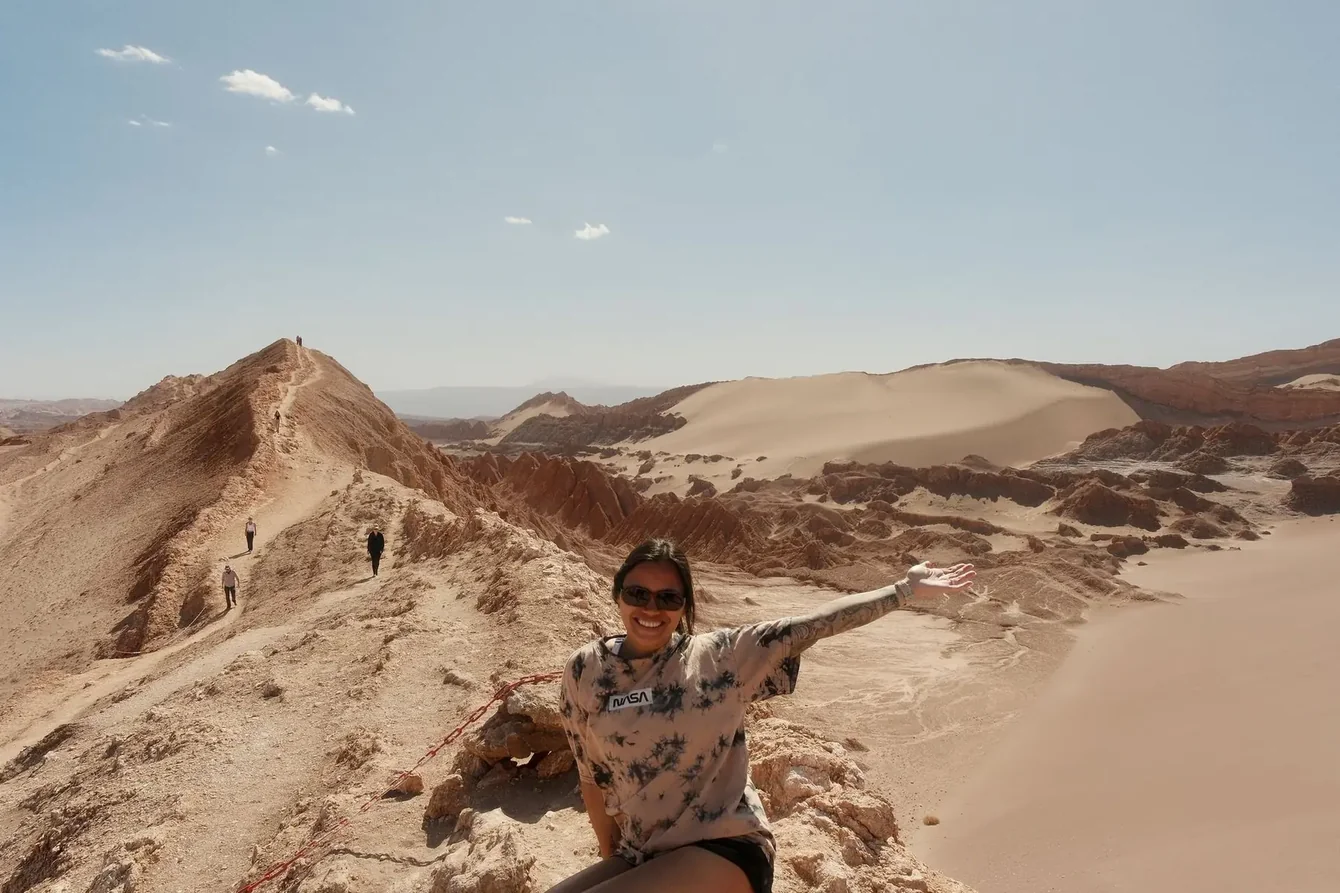
Valle de la Luna at golden hour. Salt rocks, dunes, the kind of sky photographers chase.
Where to stay
Three nights here are built into the Travesía price. All-inclusive with daily guided excursions, three pools, and a stargazing observatory on property. Same operator who will run your crossing into Bolivia.
Hito Cajón & the Eduardo Avaroa Reserve
The Crossing Begins
What is the Atacama to Uyuni 4x4 crossing?
On the morning of day four your Explora guide and 4x4 collect you. Bags packed light. What follows is three days of the most extraordinary driving on Earth. The route varies seasonally with weather and conditions, but the essential geography holds.
From the moment you cross into Bolivia the trip becomes fully private: just the two of you, your guide, and your driver in a single 4x4 fitted with satellite communications, GPS, and supplemental oxygen. Explora's altiplano guides are Wilderness First Responder certified and have driven this route for years. You are off-grid but not unattended.
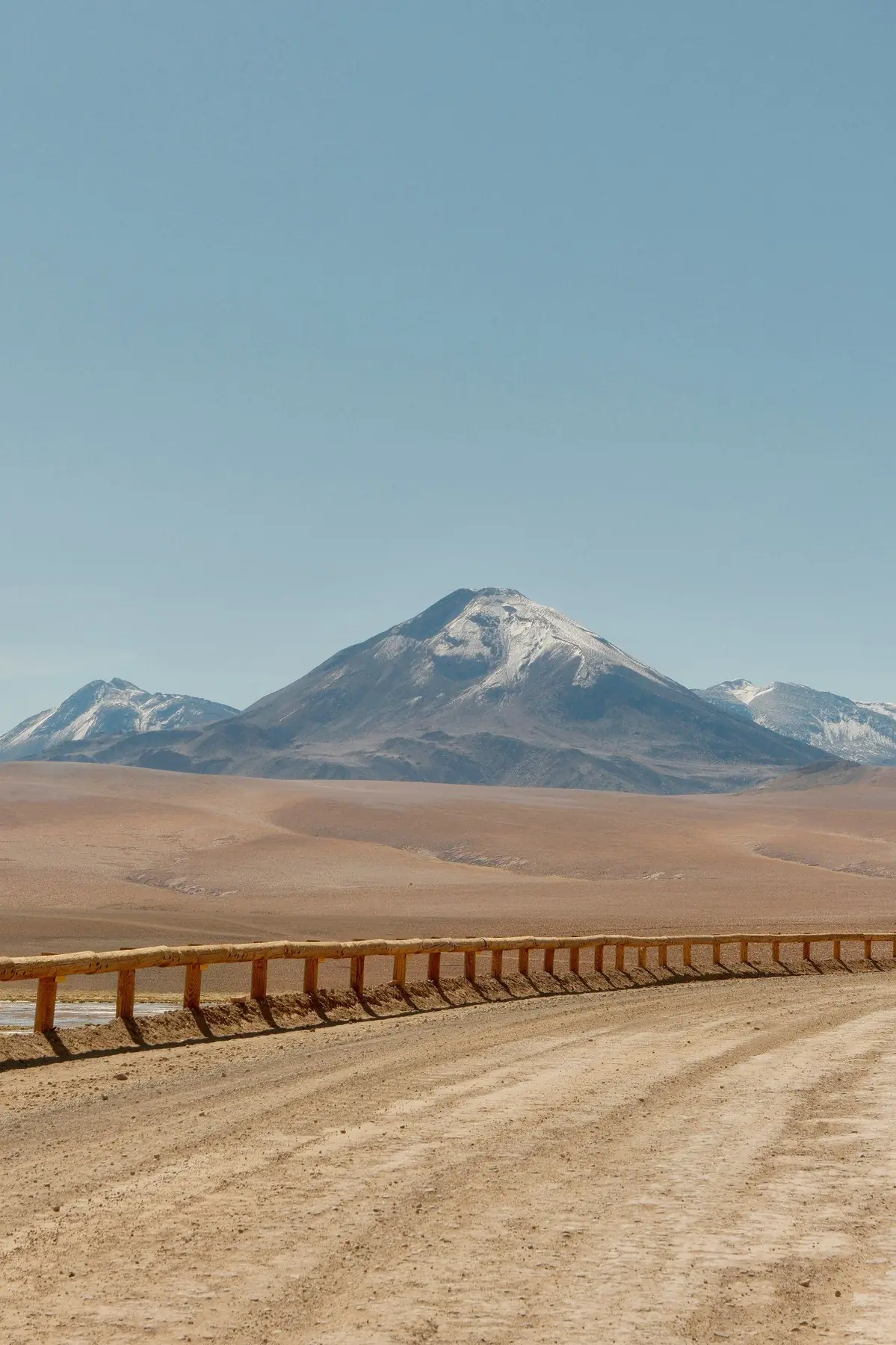
The route out of Atacama, climbing toward the Bolivian border at Hito Cajón.
Hito Cajón → Laguna Verde → the Dalí Desert
The border crossing is at Hito Cajón, a small post on a high pass. Bolivian formalities take an hour. From there you drop into a different country and a different world.
Laguna Verde sits at the foot of Licancabur, the perfect cone of a volcano that defines the horizon. The lagoon is the colour of green sea glass, and on a still morning the volcano reflects on it in full. Walk the rim. Drink the air.
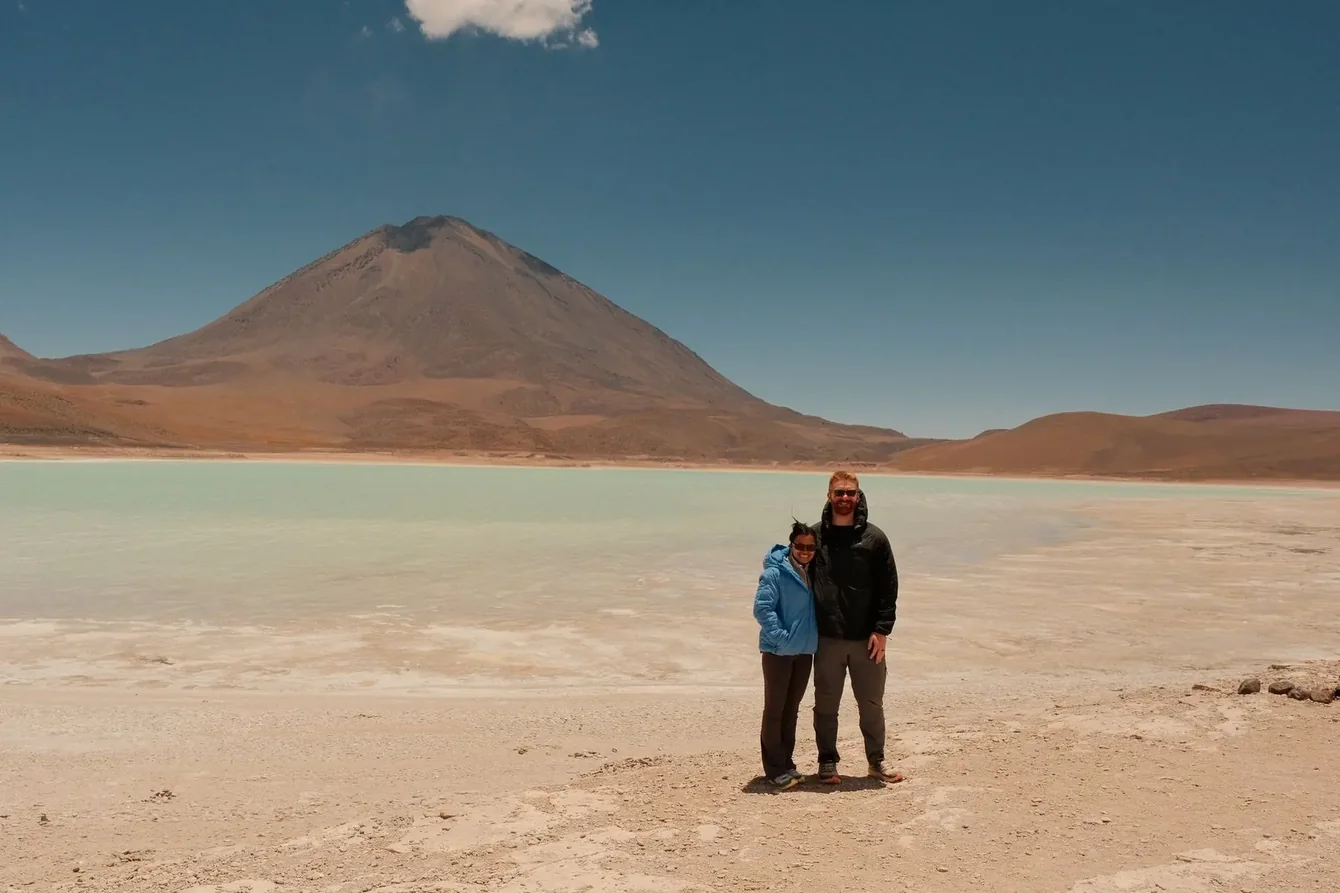
Laguna Verde with Licancabur behind. The water shifts from teal to deep green as the wind picks up.
Sol de Mañana, Laguna Colorada, Ramaditas
From Laguna Verde the route climbs onto the high plateau. Sol de Mañana is a geyser field at 4,850 m / 15,900 ft. Steam rises from boiling mud pits and fumaroles in a landscape that feels prehistoric. The smell is sulphur. The light is hard. The temperature is cold. You will not forget it.
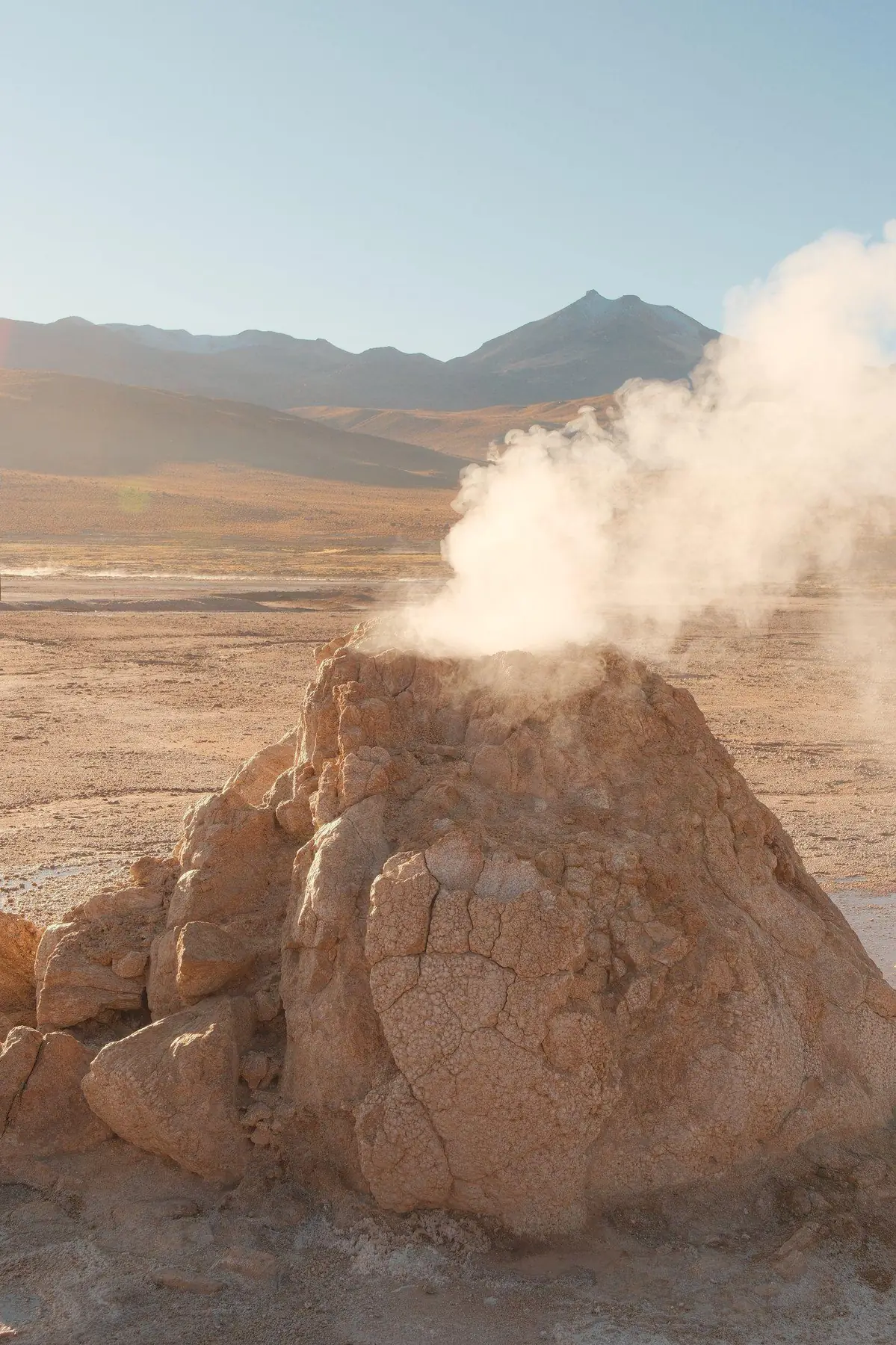
Sol de Mañana geysers at 4,850 m. Stand upwind.
After the geysers, the route descends to Laguna Colorada, a wide red lagoon stained by mineral algae, ringed by salt deposits and dotted with three species of flamingo (Andean, James's, and Chilean). They feed in the shallows in the hundreds. Pink against red against white.
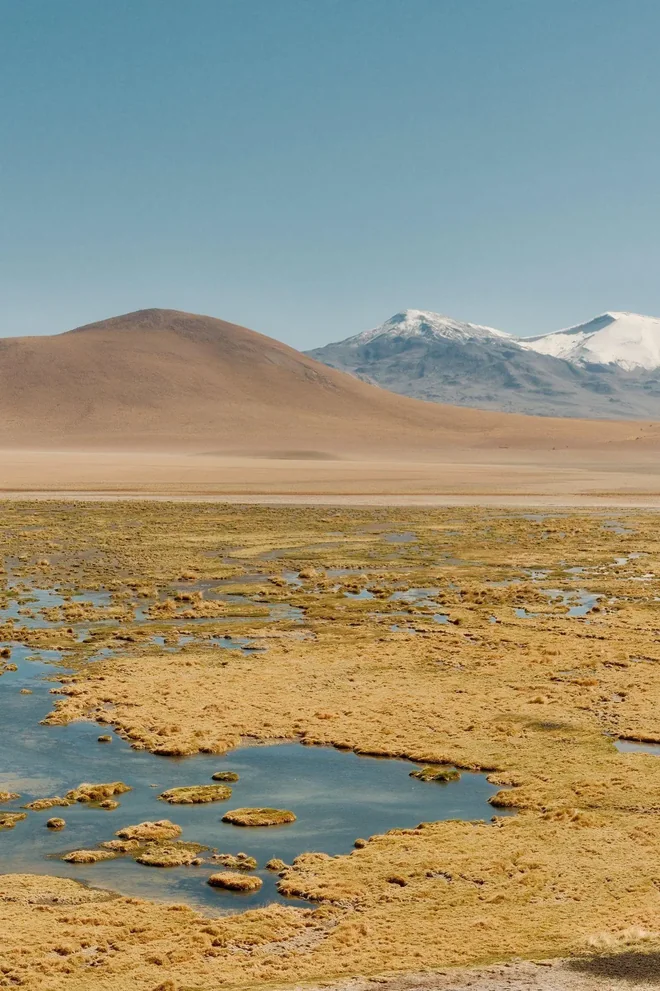
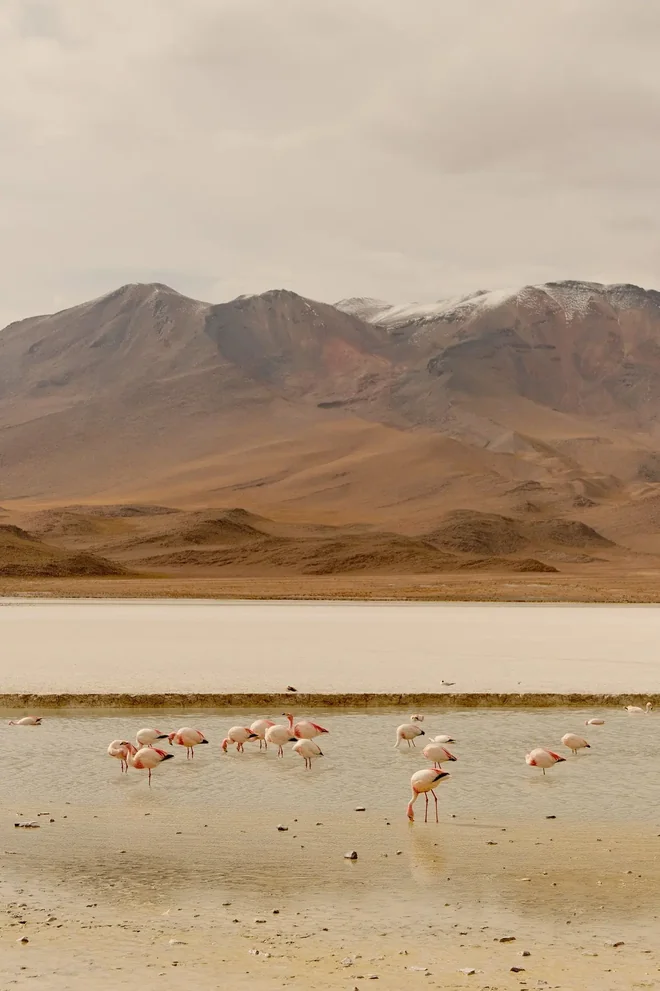
Left: a sister lagoon along the day's route. Right: three flamingo species share the shallows of Laguna Colorada.
By late afternoon you reach Ramaditas, your first Explora camp inside the Eduardo Avaroa Andean Fauna Reserve: heated tents, hot dinner, the southern sky doing its work.
Where to stay
Across the Siloli Desert
The Stone Tree, the Vicuña Plain, the Second Camp
What is the Árbol de Piedra, the Stone Tree?
Day five climbs out of camp and crosses the Siloli Desert, a high-altitude wind-sculpted plateau the colour of bone. Halfway across it stands the Árbol de Piedra, the Stone Tree: a six-metre rock formation eroded into a slender trunk by 6,000 years of altiplano wind. You stop. You walk around it. You feel small in a useful way.
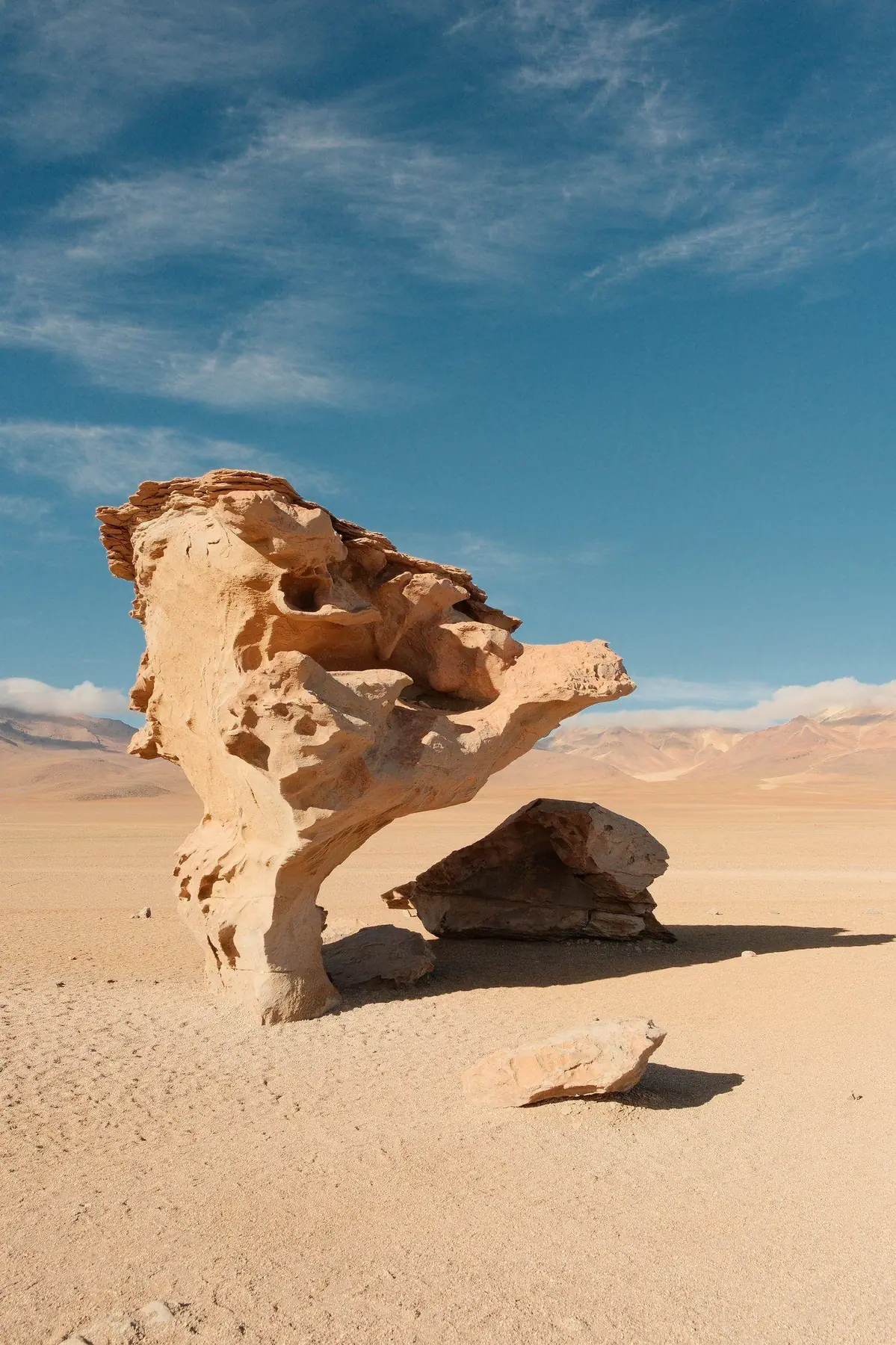
Árbol de Piedra. Six thousand years of wind.
Wildlife notes
Viscachas, long-tailed rabbit-like rodents, sun themselves on the rocks. They will come surprisingly close and just sit and watch you, completely unbothered. Stay still and they'll stay too. Vicuña graze on the plain. Andean condors circle overhead if you're lucky.
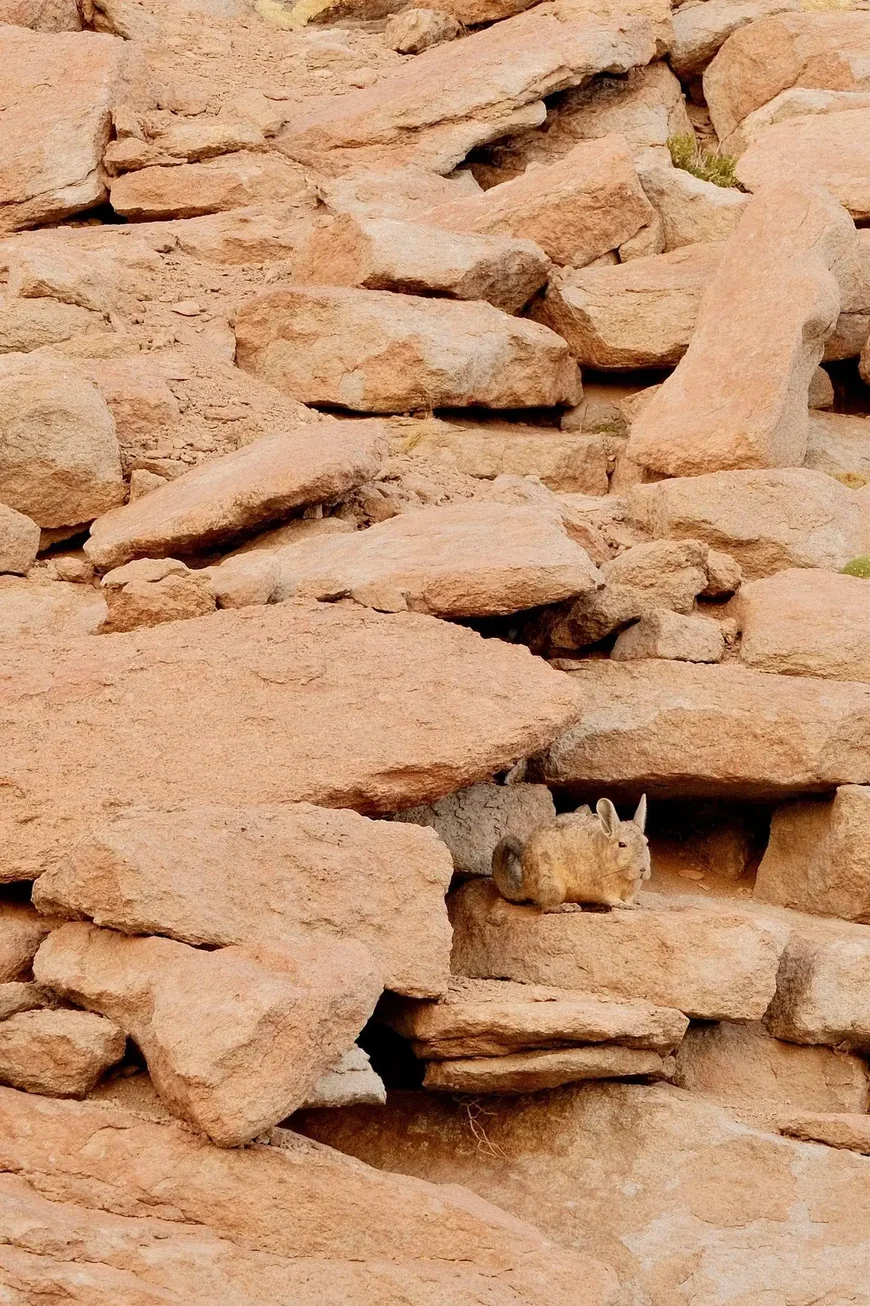
A viscacha holds still on the rocks above camp.
By afternoon the route reaches Turquiri Lagoon, set in a quiet basin where vicuña come down to the water at the edge of the day. From there you continue to Chituca, the second Explora camp, set further north on the altiplano. The second night in camp closes the camping rhythm: drive, stop, walk, eat, sleep early.
Where to stay
Cactus Forest to the Salt Flat
Down to the Salt Flat
Day six is the descent. You leave Chituca and drop slowly toward the southern edge of the Salar de Uyuni, the air thickening as you lose altitude. The landscape softens: from raw altiplano to cactus forest, then to the ruined village of San Pedro de Quemes, a former Spanish settlement abandoned after the Pacific War. Stone walls, no roofs, the silence of a place the country agreed to leave behind.
From there the route reaches the Gruta de las Galaxias, the Galaxy Cave: a network of coral-like volcanic rock formed when lava flows met an ancient lakebed. You walk through arches and chambers shaped like petrified surf. Bring a headlamp; the deeper sections are dark.
By midday you reach the eastern edge of the Salar. Pescado Island (Isla Pescado), a cactus-covered outcrop standing alone in the white, is the first salar landmark. You stop, walk it, take the photographs, and then drive on across the salt toward Explora Uyuni.
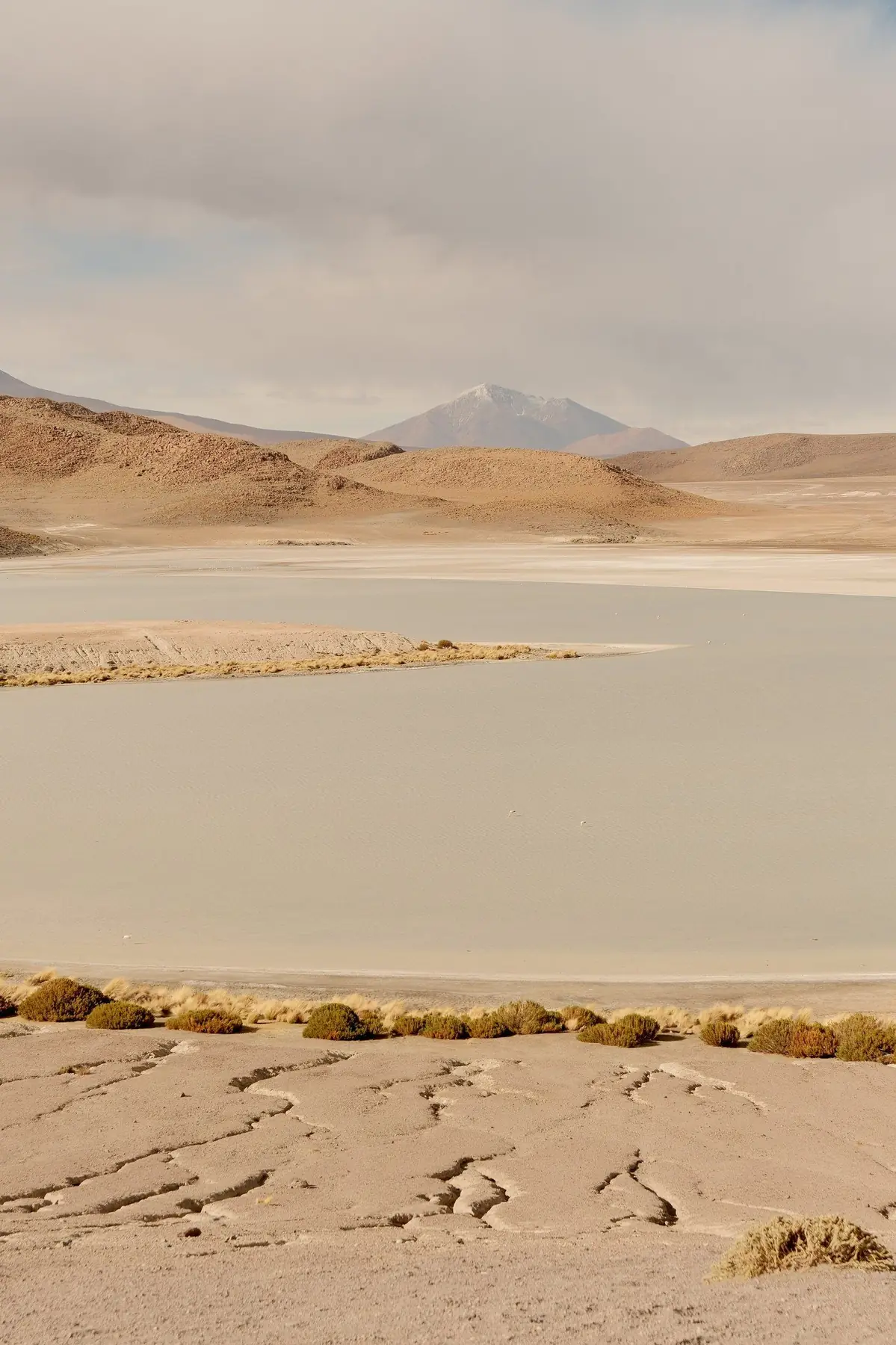
One of the last altiplano lagoons before the descent. The colour shifts hour by hour.
Into Uyuni town, then Explora Uyuni
Late in the afternoon the route swings past Uyuni town on the way to the lodge. It's worth stopping. The road skirts the Cementerio de Trenes, the train cemetery, where rusted nineteenth-century steam locomotives sit abandoned on the salt. A quiet, strange detour. Worth ten minutes.
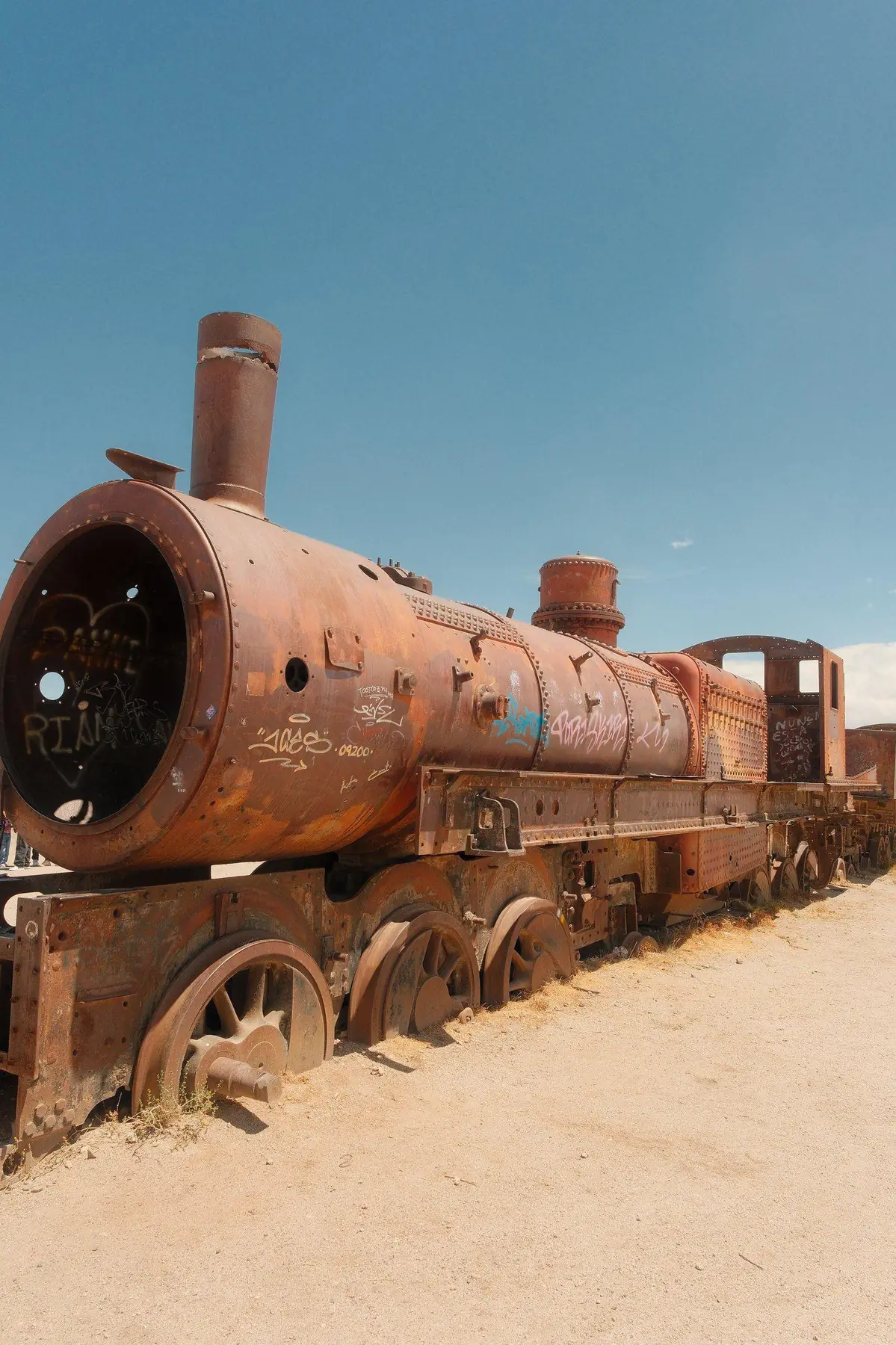
The Cementerio de Trenes outside Uyuni. A century of rust.
You'll also pass Plaza de las Banderas, a salt-edged plaza ringed with the flags of every country a visitor has ever brought. Find the U.S. flag. Take the photo.
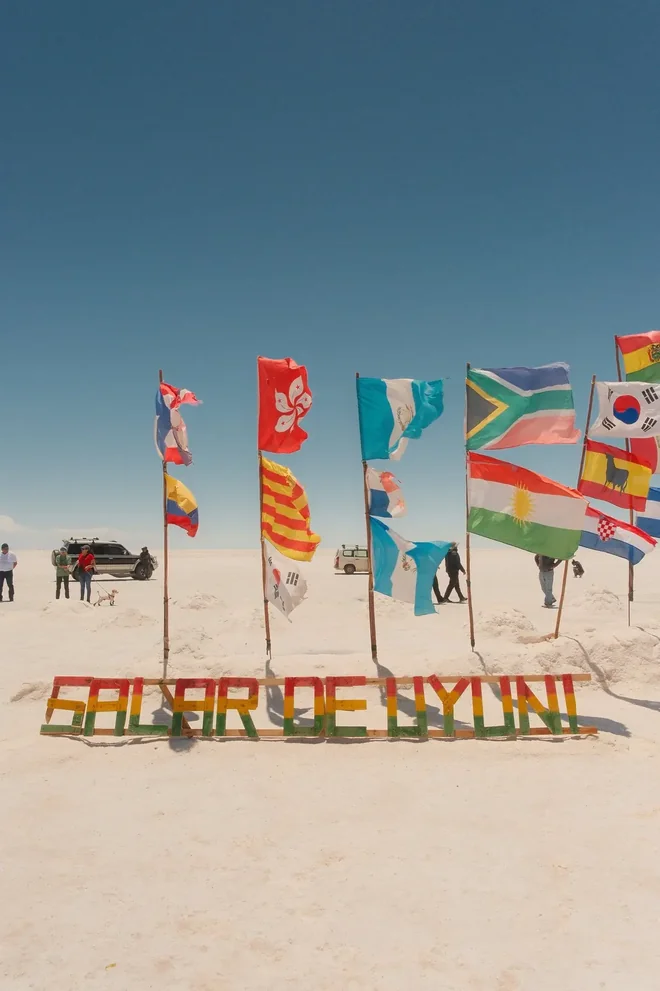

Left: Plaza de las Banderas, salted by wind. Right: Bumblebee, Uyuni edition. One of several welded-scrap sculptures in the same plaza.
A note on Uyuni town
It has its own scrappy character. There's a yellow Transformer sculpture in the plaza made entirely from old car parts, and the same plaza holds a small collection of other welded-scrap sculptures (a robot dinosaur, an oversized scorpion, a few abstract pieces). All built by local artists from the same salt rust. Bolivia is unsentimental and surprising. Lean into it.
By late afternoon you're at Explora Uyuni, their newer camp on the edge of the salt flat. After two nights in expedition camps this feels like landing. Floor-to-ceiling windows look out across the salt; a small spa is there for thawing out. You arrive into the same operator you started with six days earlier, which matters more than it sounds.
Where to stay
Salar de Uyuni
The Day the Trip Is Named For
What is the Salar de Uyuni mirror effect?
You leave camp before sunrise. The salar is more than 10,500 square kilometres of salt, bigger than Lebanon. In the dry months (May to November) it is a hexagonal-tiled white plain that stretches past the horizon. In the wet months (December to April) a few inches of standing water turn it into the largest natural mirror in the world.
You spend the morning driving across the salt, stopping to walk on it, to take the perspective photos (a 35mm lens, a small object, your two figures: the salar plays tricks with depth), to find a quiet spot and stand there.
Lunch can be set up on the salt itself if your guide arranges it: a table, two chairs, white in every direction. Sunset on the wet salar, if you've timed it right, is the moment most couples remember above everything else.
Salt flats both wet and dry.
A few seconds on the salar. There is no better way to convey scale.
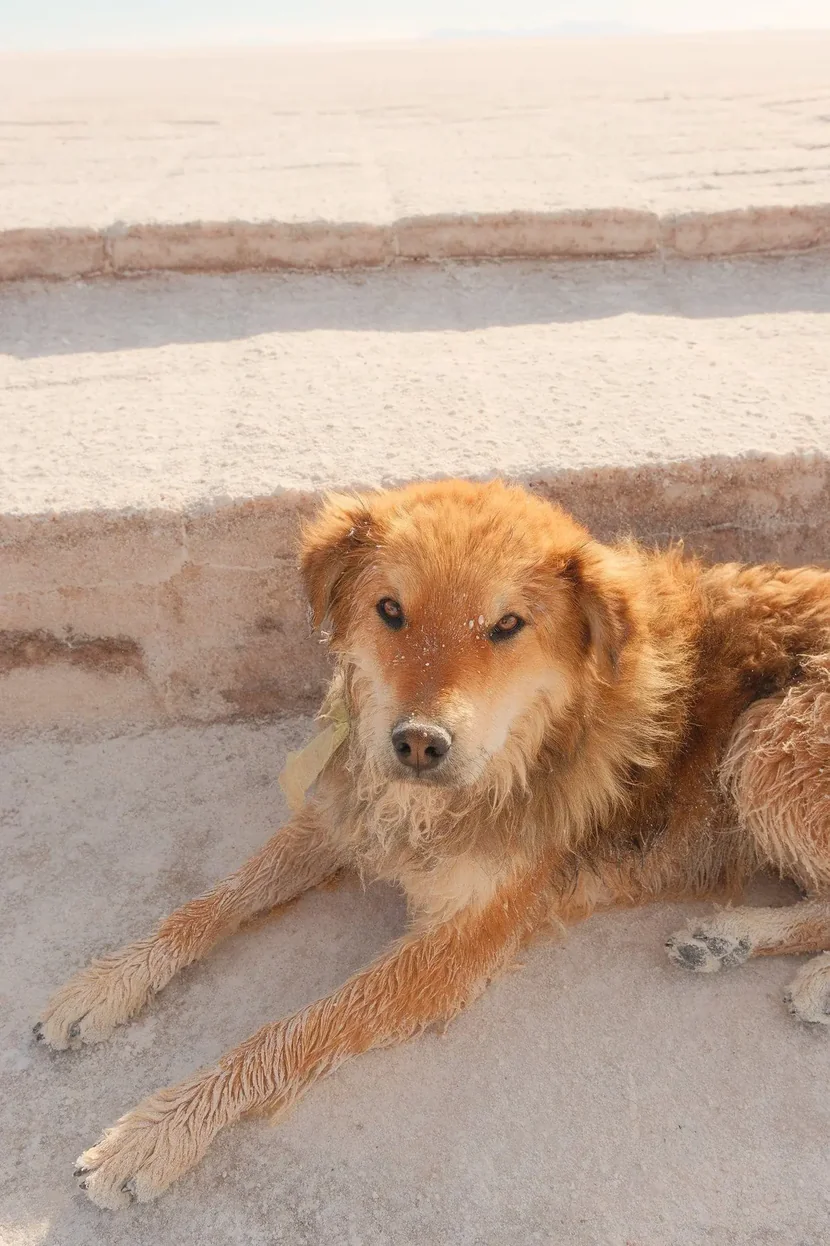
This little guy was sitting alone on top of the Staircase to Heaven sculpture, literally in the middle of the salt flats. No town, no people, no other dogs in sight. He let me take his picture and went back to surveying his kingdom. Bring biscuits.
Optional: Tunupa Volcano
On the northern edge of the salar stands Tunupa, a 5,432 m / 17,820 ft dormant volcano with mummies of the Andean Chullpas in caves on its lower slopes and views across the salt flat from the ridge. Explora offers a guided half-ascent as an alternative to a full salar day for couples who want the view from height. I'll flag whether the season and your acclimatization make it a good fit.
Where to stay
Uyuni · onward
Where You Go Next
The Travesía ends at Uyuni rather than circling back to Atacama. That's part of the design: the trip points one direction the whole way, and on day eight you decide what that direction was for.
Fly home from Uyuni
There are daily commercial flights from Uyuni (UYU) to La Paz, with same-day connections to Santiago, Lima, or São Paulo for the long-haul leg back. If your honeymoon is a focused eight-day trip, this is the cleanest landing.
Add a softer landing in La Paz or Sucre
A night or two in La Paz (cable cars over the city, a good final dinner) or in Sucre (white colonial architecture, lower altitude, slower pace) takes the edge off the long flight home.
Extend the honeymoon
The Travesía can also be extended. The pairings below go deeper.
Why this works as a honeymoon
Privacy by default. You're in a private vehicle for the entire crossing. The camps hold a handful of couples at most. There is no buffet, no swim-up bar, no anyone-else-on-your-trip.
Shared difficulty earns shared memory. The altitude is real. The cold at night is real. The early mornings are real. You handle them together. That's the part that stays.
The salar at sunset. It's the most photographed place in South America for a reason. Doing it on day seven of a journey that crossed an entire desert, on the trip you took together, hits differently than flying in for a single tour day.
Know before you go
Best time to go
The trade-off is mirror vs. clarity. December to April: standing water, mirror photos, occasional weather closures, deeper salt. May to November: dry, hexagonal, no mirror, cold nights but reliable. For honeymoons I usually point couples to late March or early April, when the rains are tapering, the mirror is still there, and the roads are passable.
Altitude
You'll spend two nights at 4,200 to 4,500 m on the Travesía, plus two more at Explora Uyuni at 3,650 m. Three days in Atacama at 2,400 m beforehand is the right buffer for most people. I'd also recommend talking to your doctor before the trip about a prescription for Diamox (acetazolamide), the standard altitude sickness medication.
Documents
Good news for U.S. travelers: Bolivia no longer requires a paid visa. You'll get an entry stamp at the Hito Cajón border crossing into Bolivia, and another stamp if you fly out via La Paz. A passport with at least six months validity and two blank pages is all you need. You will also need to complete a brief online registration through Bolivia's SIGEMIG migration system before arrival. I'll walk you through this during pre-trip prep.
Packing
Layers. Daytime can hit 70°F; nighttime drops below freezing. Sun is brutal at altitude: high SPF, real sunglasses, a brimmed hat. Sturdy waterproof boots for the salar in wet season. A small dry bag for the camera.
Connectivity
Spotty in Atacama, none in the Bolivian camps. Plan to be off-grid for two days. Most couples find this is the gift of the trip.
Investment
Explora's Travesía program starts at around $8,400 per traveler, or roughly $16,800 for two, all-inclusive. The program can be extended up to eleven nights total for additional time on the salar or in the altiplano. The Atacama portion is shared with up to eight other guests on excursions and meals; the Bolivia crossing is fully private from the moment you reach the border.
What's included
Beyond the inclusions listed at the top of this page, you have full use of the lodge facilities: the three pools and observatory at Atacama, the spa at Uyuni, and a small wine cellar at every property.
Explora has won World Travel Awards for its South American programs and it shows in the small things: the way the staff remember which side of the bed you slept on the night before, the wine pulled from a small cellar in the middle of the salt flat, the guide who knows when to talk and when to leave you with the view. I work directly with Explora and can structure dates, inclusions, and extensions to your preferences.
Fora Reserve Perks
Booked with me, you also receive:
- Upgrade on arrival, subject to availability.
- USD 100 equivalent resort or hotel credit during the stay (not combinable, not valid toward the room rate, no cash value if not redeemed in full).
- Early check-in and late check-out, subject to availability.
If you want a longer honeymoon
The Travesía is a strong centrepiece. If you want the trip to keep going, the easiest add-ons are at other Explora properties, where the same all-inclusive operating standard carries through.
Explora Patagonia (Chile)
Five to seven nights at Explora Patagonia inside Torres del Paine National Park. A glacier-and-granite second movement after the desert. Daily guided hikes from the lodge, panoramic views of the Paine massif from the rooms. The most logical pairing if you want everything under one operator.
Explora El Chaltén (Argentina)
Explora's newest Patagonia property, on the Argentine side near Mount Fitz Roy. Four to five nights of granite spires, glacier walks, and the trekking village of El Chaltén below. Pairs naturally with Explora Patagonia for a two-country Patagonia chapter.
Explora Sacred Valley & Machu Picchu
Fly La Paz to Cusco. Four to six nights at Explora Sacred Valley, with day trips to Machu Picchu and the surrounding Inca sites. Different altitude, different culture, the perfect counterweight to a week in Bolivia.
Buenos Aires & Iguazú
Land at Iguazú Falls for two nights, then three in Buenos Aires for steak, wine, and tango before the flight home. Argentina rounds out the trip with warmth and cities after a week of high-altitude silence.
Curated through Journeys with JB's trusted travel partnerships · Powered by Fora Travel · Virtuoso Affiliate
Frequently Asked
Is this honeymoon customizable?
Completely. I can extend the time on the salar, add a softer landing in La Paz or Sucre, or layer on Patagonia, Sacred Valley & Machu Picchu, or Buenos Aires & Iguazú on the back end. Explora's Travesía can be stretched up to eleven nights total within the same all-inclusive program.
When is the best time to go?
The trade-off is mirror vs. clarity. December–April brings standing water and the famous mirror effect; May–November is dry, hexagonal, and reliable. For most honeymoons I point couples to late March or early April, when the rains are tapering, the mirror is still there, and the roads are passable.
How is the altitude managed?
Three days in Atacama at 2,400 m before crossing into Bolivia is the buffer most people need. The Travesía vehicles carry supplemental oxygen and the guides are Wilderness First Responder certified. I also recommend asking your doctor about a Diamox prescription before the trip. I can talk you through the timing during pre-trip prep.
Why Explora rather than a different operator?
Continuity. The same operator runs your Atacama lodge, the private camps in Bolivia, and the lodge at the salar. Same staff, same vehicles, same standard across both countries. The Bolivia crossing is fully private: just the two of you, your guide, and your driver in a single 4x4. That's not the default in this part of the world, and it's the reason the trip works as a honeymoon.
How do I book?
Fill out the inquiry form below and I'll reach out within 1–2 business days. On our first call we'll talk through your dates, what you're after, and how I work, including any planning fees for a custom itinerary like this one.